This video shows a demo of the game I am developing, Brimming Sea. It's a strategy adventure game which combines elements of first person action and third person strategy in a sandbox voxel environment. The world of the game is procedurally generated, and all the art in the game was created using my voxel editing software Cube Studio (detailed below). Visit BrimmingSea.com to see more.
Skills: C# and HLSL languages, DirectX graphics framework

In order to detect road signs, I used LBP classifiers trained with a combination of real world samples and realistic artificial samples I generated using shaders. Training with the artificial samples produced a substantial improvement in the overall performance of the classifier over one which was trained only on real world samples, but it was still too slow and had too many false positives. This is why we are moving toward image segmentation to increase speed, and support vector machines to improve classifier accuracy.
I used edge detection kernels and statistical analysis to find lane markings on roadways in real time. The app will issue warnings to our users if they drift from their lanes.
The system uses LBP classifiers to detect cars on the roadway and warn the driver of unsafe following distances. Since cars have features which lend themselves naturaly to LBP classification, we have achieved satisfactory perfomance of our car detector. It is also faster than the LBP based sign detector because a car which a user is following will take up a larger portion of the image than will a sign, so the sliding window method we use for finding the cars does not take nearly as long as it does with signs.
Skills: OpenCV framework, Haar cascade training, C#, HLSL
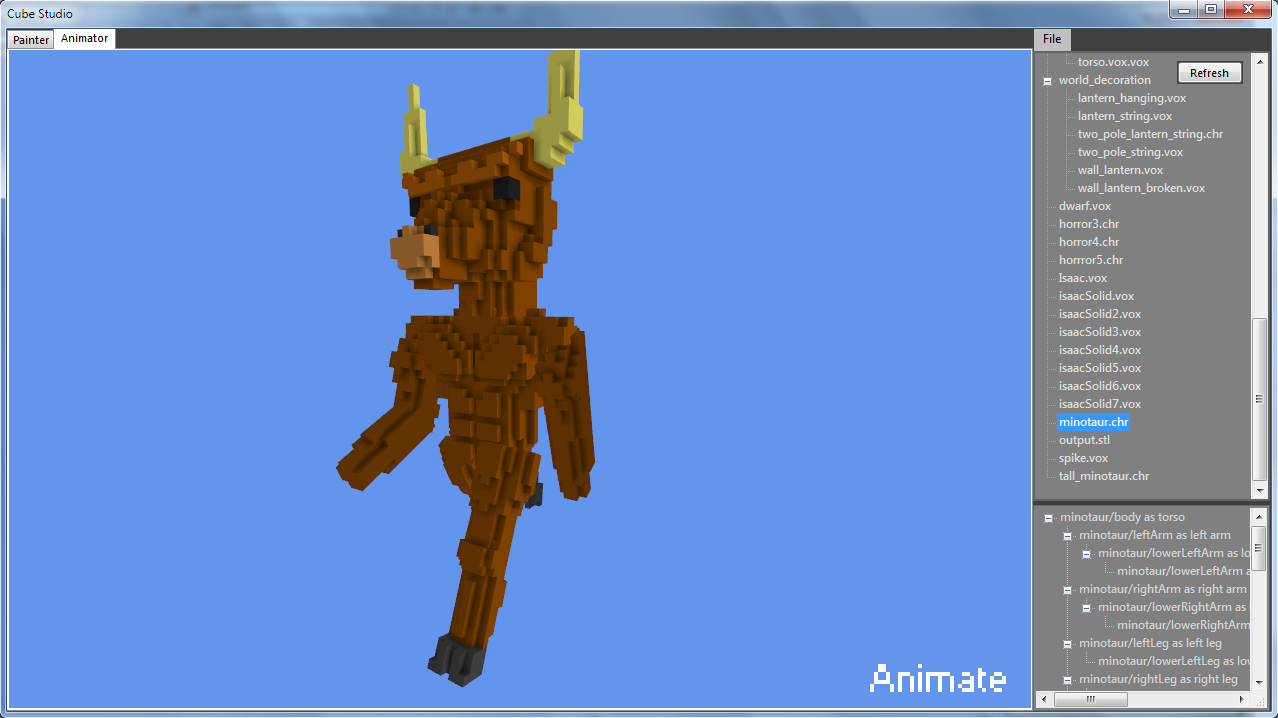
By creating Cube Studio, I seek to automate many of the tasks that make creating animated characters so labor intensive. Procedural animation and super simple modelling allow users to create fully rigged and animated models in minutes with no previous experience.
The program's user interface contains two main tabs: one for buidling, and one for character assembly and animation. In the building tab, users can create voxel models, which can be used on their own in projects or combined with other models to create characters. Characters are built in the animation tab, where users select voxel models they have built and attach them to each other. The users is prompted to select what kind of joint each attachment is (knee, shoulder), so that the program knows how that joint should move when the character performs animations. With one click the program fully animates the character, which is now ready can be exported and used in a game, as is seen in the Graphics and Games video.
Cube Studio can also export its voxel models to 3D printers using the standard STL format. It's the simplest CAD software you'll ever use, provided you only need to build with cubes.
Skills: C# and HLSL languages, XNA framework, 3D printing and STL formatting